
Symbols have always played an important role in mythology, religion, folklore, witchcraft, and occult traditions. A simple shape or image can carry meanings that have changed over centuries, depending on the culture and tradition where it appears.
Today, many of these symbols are also connected with dark art, gothic illustration, tattoo culture, jewelry, books, and alternative aesthetics. However, their historical meanings are often more complicated than their modern reputation suggests.
Some symbols associated with occult traditions were not originally created as Satanic symbols at all. The inverted cross, for example, has Christian origins as the Cross of Saint Peter, while the pentagram has been used in several religious and mystical traditions.
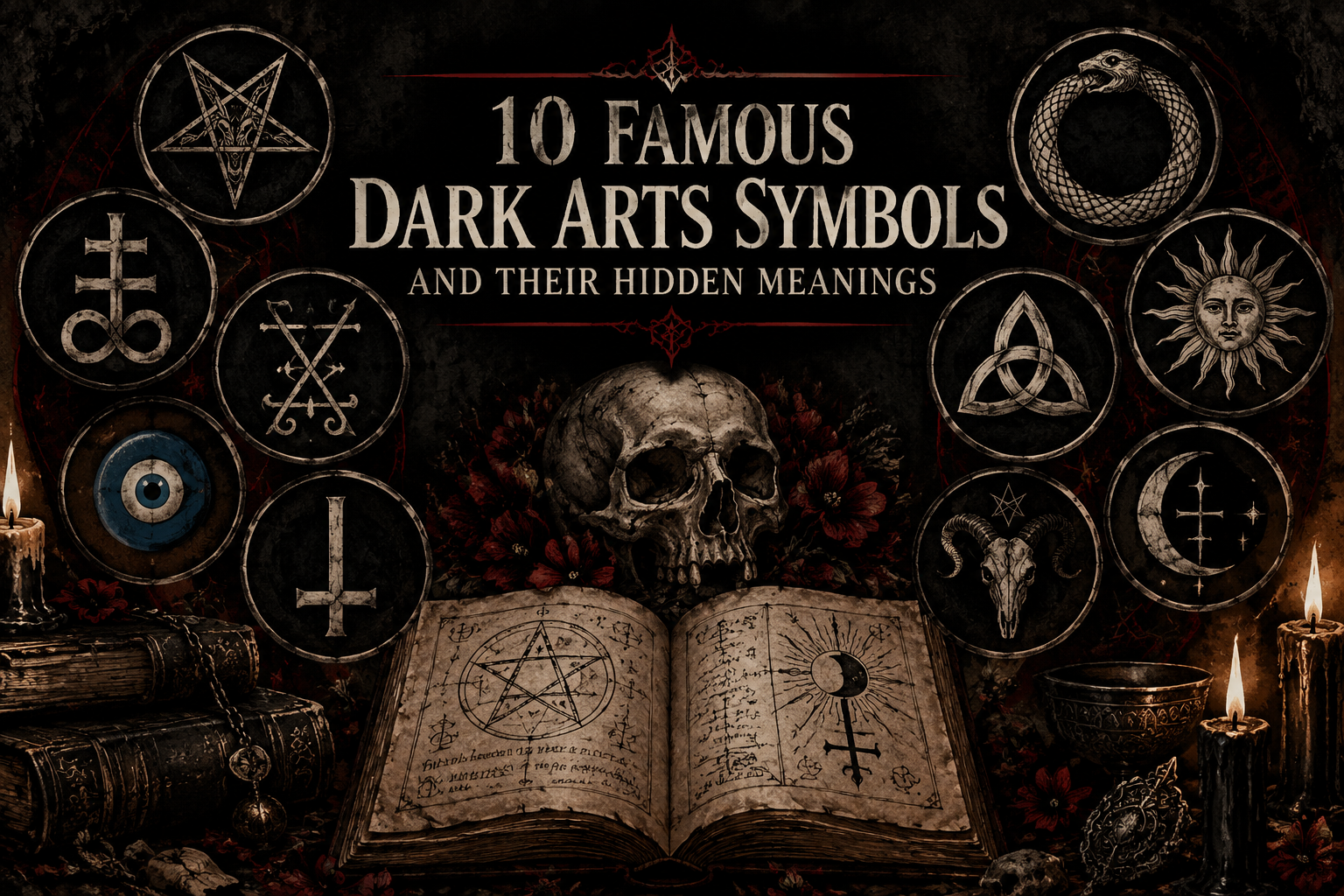
Here are 10 famous dark arts symbols and the meanings commonly associated with them.

The inverted pentagram is one of the most recognizable symbols associated with modern occult imagery.
It is a five-pointed star positioned with one point facing downward. It may appear by itself or inside a circle.
The meaning of the pentagram has changed across different traditions. An upright pentagram has historically been connected with concepts such as the four elements and spirit. The inverted form later became strongly associated with modern Satanic imagery, particularly through the Sigil of Baphomet.
Because of its dramatic shape, the inverted pentagram has also become a popular element in dark art, gothic illustrations, tattoos, album artwork, and horror-inspired designs.

The Leviathan Cross is another well-known symbol found in modern occult and Satanic imagery.
The design combines a double-barred cross with an infinity symbol at the bottom.
The symbol has historical connections to alchemy, where it represented sulfur. In contemporary Satanic traditions, it has also been interpreted through ideas of independence, personal autonomy, continuity, and human potential.
Its unusual geometric design makes it particularly recognizable in occult-inspired jewelry and dark art.

The Sigil of Lucifer is a distinctive symbol associated with Luciferian and occult traditions.
Historical versions of the symbol appeared in magical texts and grimoires. In modern interpretations, Lucifer is sometimes viewed as a symbolic figure connected with enlightenment, knowledge, independent thinking, and the questioning of authority.
The symbol has therefore developed meanings that go beyond the simple good-versus-evil interpretation often presented in popular culture.
It is also frequently used as inspiration for occult artwork, illustrations, jewelry, and other forms of dark art.
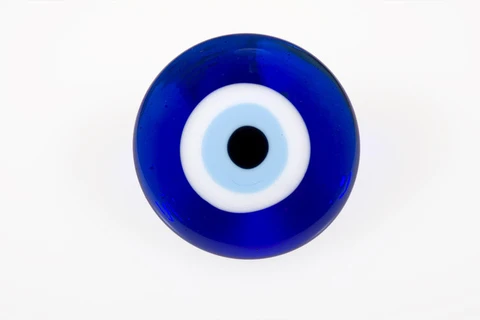
The Evil Eye is one of the oldest and most widely recognized protective symbols in popular culture.
It is commonly represented as a series of blue, white, and dark concentric circles designed to resemble an eye.
Unlike several symbols on this list, the Evil Eye is traditionally associated with protection rather than evil itself. In many cultures, protective amulets were believed to guard against harmful intentions, envy, or the unwanted gaze of others.
The symbol has appeared in many cultural traditions and continues to influence jewelry, decorative artwork, fashion, and dark art designs.
Its history shows why a symbol should not always be judged simply by its appearance.

The inverted cross is often immediately associated with Satanism in modern horror movies and popular culture. Historically, however, its story is different.
The symbol is traditionally known as the Cross of Saint Peter. According to Christian tradition, Saint Peter requested to be crucified upside down because he considered himself unworthy to die in the same manner as Jesus.
Over time, popular culture began using the inverted cross as an image of rebellion, anti-establishment ideas, and dark religious imagery.
This contrast between historical meaning and modern representation is one reason the symbol appears so often in gothic and dark art.

The Ouroboros is an ancient symbol showing a serpent or dragon consuming its own tail.
The circular design is commonly associated with cycles, eternity, renewal, and the continuous process of destruction and rebirth.
Rather than representing darkness alone, the Ouroboros can symbolize the idea that endings and beginnings are connected.
Its dramatic appearance has made it popular in fantasy artwork, occult illustrations, tattoos, jewelry, and dark art.
The symbol works particularly well visually because the serpent creates a complete circle with no obvious beginning or end.

Hecate’s Wheel is associated with Hecate, a figure from ancient Greek tradition connected with crossroads, magic, night, and the underworld.
The symbol generally features a labyrinth-like design with three interconnected sections or swirling forms.
Different modern interpretations connect the wheel with cycles, transformation, crossroads, and spiritual journeys.
Its maze-like appearance also gives it a strong connection to mystery and hidden knowledge, making Hecate’s Wheel a natural subject for gothic illustration and dark art.
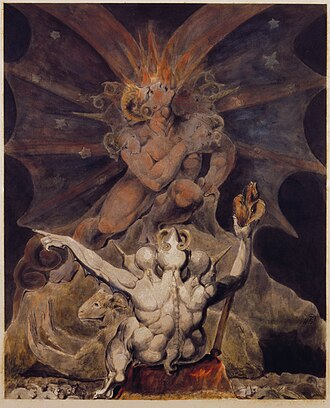
Few symbols have created as much cultural fascination as 666.
The number is known from the Book of Revelation as the “number of the beast.” Because of this biblical association, it became strongly connected with Satan, evil, horror, and apocalyptic imagery.
However, interpretations of the number have varied throughout history.
Today, 666 appears frequently in horror movies, music, tattoos, clothing, graphic design, and dark art. Its recognition makes it one of the easiest symbols for audiences to identify with occult or horror themes.
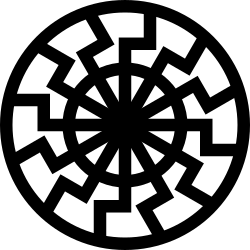
The Black Sun is a complex symbol with a particularly complicated modern history.
It is generally represented as a circular design containing multiple radial shapes arranged around a center.
Some interpretations connect the idea of a black or hidden sun with esoteric concepts of mystery, hidden knowledge, or an unseen source of illumination.
However, the symbol also has a documented association with Nazi-era and later extremist imagery. Because of that history, its use today can carry meanings beyond the broader occult or esoteric context.
This is an important reminder that symbols can acquire new meanings as they move between cultures, historical periods, and movements.

Baphomet is perhaps one of the most recognizable figures in modern occult imagery.
The well-known modern depiction shows a winged, goat-headed figure with both masculine and feminine characteristics. The image was created by French occultist Éliphas Lévi in the 19th century.
Lévi’s original imagery incorporated several opposing ideas into one figure. Its symbolism has been interpreted through concepts such as balance, duality, knowledge, and the union of opposites.
Modern depictions have also become closely associated with Satanism and popular occult culture.
Because of its highly detailed visual structure, Baphomet has become a major influence on tattoos, posters, illustrations, sculptures, and dark art.
The appeal of these symbols is not necessarily connected to belief in the traditions behind them.
Artists often use occult and gothic imagery because symbols can create mystery, atmosphere, contrast, and visual storytelling. A pentagram, skull, serpent, moon, or mysterious figure can communicate an idea before the viewer reads a single word.
This is especially noticeable in dark art, where artists often combine historical symbols with strange characters, surreal environments, gothic architecture, and macabre themes.
For example, a dark art journal can turn these visual ideas into something interactive. Instead of simply looking at an illustration, readers can write, sketch, or develop their own creative ideas around it.
For people who enjoy this style, the Organized Madness journal from Grimm House of Ink combines detailed pen-and-ink artwork with a 200-page creative journal experience. The artwork reflects the strange, imaginative atmosphere that attracts many fans of gothic and dark art.
One of the most interesting things about occult and dark symbols is that their meanings are rarely fixed.
A symbol can begin in one religious or cultural tradition, become associated with another movement centuries later, and eventually become an artistic element in modern popular culture.
The inverted cross is a good example. Its original association with Saint Peter differs significantly from its modern use in horror and Satanic imagery. Similarly, the pentagram has appeared in different religious and mystical traditions before becoming strongly associated with modern occult culture.
Understanding that history makes dark art more interesting because the imagery becomes more than decoration. Each symbol can carry layers of history, interpretation, and cultural meaning.
Dark arts symbols continue to influence artists, writers, designers, musicians, and creators around the world. From the inverted pentagram and Leviathan Cross to the Ouroboros and Baphomet, each symbol has a story that extends beyond its modern reputation.
Some represent transformation. Others are connected with protection, knowledge, rebellion, balance, or mystery. Their meanings can also differ depending on the tradition and person interpreting them.
That complexity is exactly what makes these symbols so powerful in dark art and gothic creativity. They give artists a visual language for exploring ideas that are difficult to express through ordinary imagery.
For anyone fascinated by strange symbols, gothic aesthetics, unusual illustrations, and creative storytelling, exploring their history can be just as interesting as appreciating the artwork itself.
The inverted pentagram, Baphomet, and 666 are among the symbols most commonly associated with modern occult and dark imagery.
No. Many symbols associated with occult imagery have older religious, cultural, philosophical, or alchemical origins. Their meanings can vary considerably.
Its meaning varies by tradition, but it became strongly associated with modern Satanic imagery and the Sigil of Baphomet during the 20th century.
Baphomet has been interpreted through ideas including balance, duality, knowledge, and the union of opposing forces. Modern interpretations vary.
Occult symbols provide strong visual themes involving mystery, history, mythology, transformation, and the unknown, making them popular elements in gothic and dark art.